Major Performance Improvements

This release focuses on speed, stability, and everyday workflow refinements. The app runs faster, especially on older devices, moving films and folders is clearer and more flexible, and several interface issues have been resolved to make interactions feel more consistent.

Frames film photography app performance improvements and move screen updates

Faster and More Stable

Major speed and stability improvements have been implemented across the app. Library navigation, film editing, and general interactions are noticeably more responsive, particularly on older iPhone models. The goal is simple: less waiting, more focus on your work.

Improved Move Workflow

The Move screen now includes a contextual header that clearly shows what you are moving and where it will go. Films can now be moved, edited, and exported without dismissing the recorder toolbar, making it easier to manage rolls without interrupting your flow.

Refinements and Fixes

Purchase restoration is now more reliable when switching devices. The Welcome screen has been clarified for iOS 26 to avoid confusion during first launch. Animation issues when deleting films or folders with a swipe gesture in lists have also been fixed, resulting in more predictable behavior throughout the app.

Improvements (5)

  • Major speed and stability improvements, especially on older devices
  • Contextual header added to the Move screen for better clarity
  • Move, edit, and export films without closing the bottom toolbar
  • Improved purchase restoration reliability when switching devices
  • Clearer Welcome screen presentation on iOS 26

Fixes (1)

  • Swipe to delete animations: Fixed animation inconsistencies when deleting films or folders using a swipe gesture in lists.

Patches (1)

  • 1.22.1: Additional performance improvements

JPEG XL Support & Metadata Export

This update adds support for JPEG XL to the Mac app. You can now embed your capture data directly into .jxl files when exporting scans, alongside JPEG, TIFF, and DNG. The release also includes minor UI improvements.

Frames macOS app exporting metadata to JPEG XL

JPEG XL & Metadata

Frames for Mac now supports JPEG XL. When exporting your scans, you can embed data captured via the iPhone app directly into .jxl files, just as you can with JPEG, TIFF, and DNG. This ensures your images remain fully documented across modern file formats while keeping your film photography workflow consistent.

Embedded metadata includes image number, date and time, GPS coordinates, aperture, shutter speed, exposure program, exposure mode, exposure compensation, flash, metering mode, focal length, focus distance, subject distance range, lens make and model, lens serial number, lens specification, camera make and model, camera serial number, ISO speed rating, sensitivity type, and additional notes such as film stock, filters, and personal remarks.

Improvements (3)

  • Support for JPEG XL (.jxl) with embedded metadata on export
  • Capture data now writes consistently across JPEG, TIFF, DNG, and JXL formats
  • Minor UI improvements

Focus Distance in Sidebar and EXIF

This update brings focus distance support to the Mac app. If you record focus distance in Frames for iOS, that data now appears in the sidebar and gets written into the EXIF metadata when you export your scans. The update also improves how certain metadata values are handled and includes visual refinements for macOS Sequoia.

Frames macOS app showing focus distance in the sidebar

Focus Distance and Subject Distance Range

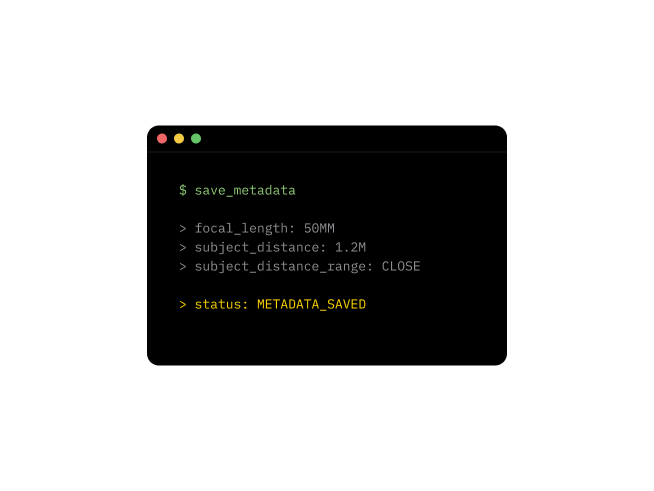
Focus distance is now visible in the sidebar alongside your other shooting data. When you export to DNG, JPG, or TIFF, this value is written to the Subject Distance field in the EXIF metadata. The app also calculates a Subject Distance Range by combining the focus distance with the focal length you used for the frame, giving image viewers and cataloging software more context about your shot.

This feature works with focus distance data recorded in Frames for iOS (version 1.21.0 and later). If you've been logging focus distance on your phone, that information now carries through to your exported files on Mac.

Improvements (6)

  • Focus distance displayed in sidebar
  • Subject Distance written to EXIF metadata for DNG, JPG, and TIFF exports
  • Subject Distance Range calculated from focus distance and focal length
  • Flash Off now written to metadata instead of being skipped
  • 0 EV exposure bias now written to metadata instead of being skipped
  • Visual refinements for macOS Sequoia, including sidebar appearance

Focus Distance Recording

This update adds focus distance to the data you can record for each frame, giving you a more complete picture of your shooting settings. The update also includes several interface improvements that make entering and reviewing your frame data more convenient.

Frames app showing focus distance recording for a frame

Track Your Focus Distance

When logging a frame, you can now record the focus distance alongside your other shooting data. Whether you were focused at 1.2 meters for a portrait or set to infinity for a landscape, this information is saved with each shot. The app reads your iOS regional settings and displays distances in meters or feet accordingly.

If you use Frames on Mac, this focus distance data can be written into the Subject Distance and Subject Distance Range fields of your EXIF metadata when exporting to DNG, JPG, or TIFF. Your focus settings stay with your scans, just like aperture and shutter speed.

Interface Improvements

Selecting focal length values is now easier, and the exposure compensation picker shows 0 EV instead of Not Set when no adjustment is recorded. Parameters also appear in a consistent order across the frame list and settings, making the app more predictable to use.

Improvements (6)

  • Record focus distance for each frame with automatic unit selection based on iOS settings
  • Easier selection when entering focal length values
  • Exposure compensation picker now shows 0 EV instead of Not Set
  • Consistent parameter order across the frame list and settings
  • Various interface improvements
  • Switch films from the recent list while the recorder stays open and updates automatically

Fixes (1)

  • Focus Distance: Fix a bug where focus distances recorded in feet were saved as meters instead of converted.

Patches (2)

  • 1.21.1: Minor UI Improvements
  • 1.21.2: Switch films faster, fixed focus distance bug

Localized Welcome Screen and Exposure Metadata

The welcome screen has been localized and refined for all supported languages. Previously available only in English, it now displays in your preferred language with clearer drag and drop guidance to help you get started.

Frames macOS app showing Exposure Mode and Exposure Program in the sidebar

Exposure Mode and Exposure Program

Exposure Mode and Exposure Program are now visible directly in the sidebar, making it easier to review this information while browsing your images. Exposure Mode displays as either Manual or Auto Exposure, while Exposure Program shows Manual, Aperture Priority, Shutter Priority, or Normal Program based on your recorded data.

These fields have also been reintegrated into the EXIF metadata when exporting to DNG, JPG, and TIFF files, so your exposure settings travel with your scans.

Improvements (4)

  • Welcome screen now localized in all supported languages with improved drag and drop guidance
  • Exposure Mode and Exposure Program displayed in sidebar
  • Exposure Mode and Exposure Program written to EXIF metadata for DNG, JPG, and TIFF
  • Visual and interaction refinements across the interface

Patches (1)

  • 1.12.1: Minor UI improvements